Chord Cycles
I’m learning music theory in public — this is me working through ideas, not teaching them.
The Tightening detects chords in real songs. Point that at a 5,323-song MIDI library and you can ask a blunt question: which chord loops actually come up, and how often? A cycle here is a run of 2 to 5 chords that returns to where it started — C G C counts as the loop C → G. Anything that appears in at least five songs made the table.
The Roman-numeral column spells each loop relative to its own first chord as “I”. That’s the loop’s shape, not the song’s key — a song in G that vamps C → D still reads I II here. Group by Roman numerals to fold every transposition of a shape into one row: C → F, D → G and A → D are all I IV.
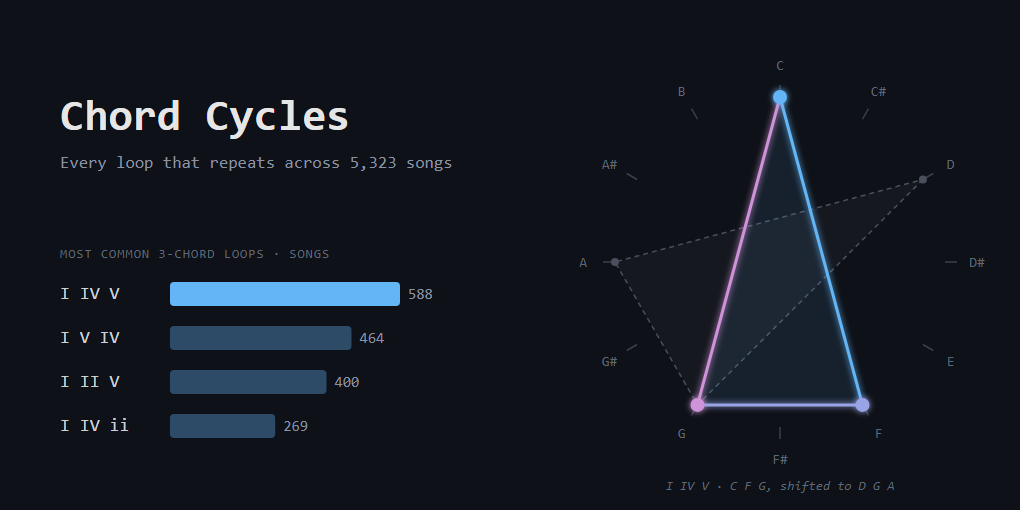
Click any row to drop it into the chord transposer on the right, then shift it into another key. The shape rotates around the circle but never deforms.
* Grouped by Roman numerals, Songs is summed across keys — a song only counts twice if it plays the same shape in two different keys.
What jumps out
- Two-chord vamps dominate.
I IVandI Veach show up in over 2,000 songs once you group by Roman numerals. Almost anything that rocks back and forth between two chords lands here, so filter by length to see past them. I IV Vis the most common three-chord loop — 588 songs across twelve transpositions.- Many “four-chord” loops are two-chord loops played twice.
I IV I IVandI V I Vtop the length-4 list. The longer, less repetitive loops start just below them.
Song counts in the grouped view are summed across keys, so a song that plays the same shape in two keys counts twice. Example songs are capped at a handful per row; the full song lists live in the-tightening’s analysis output.